


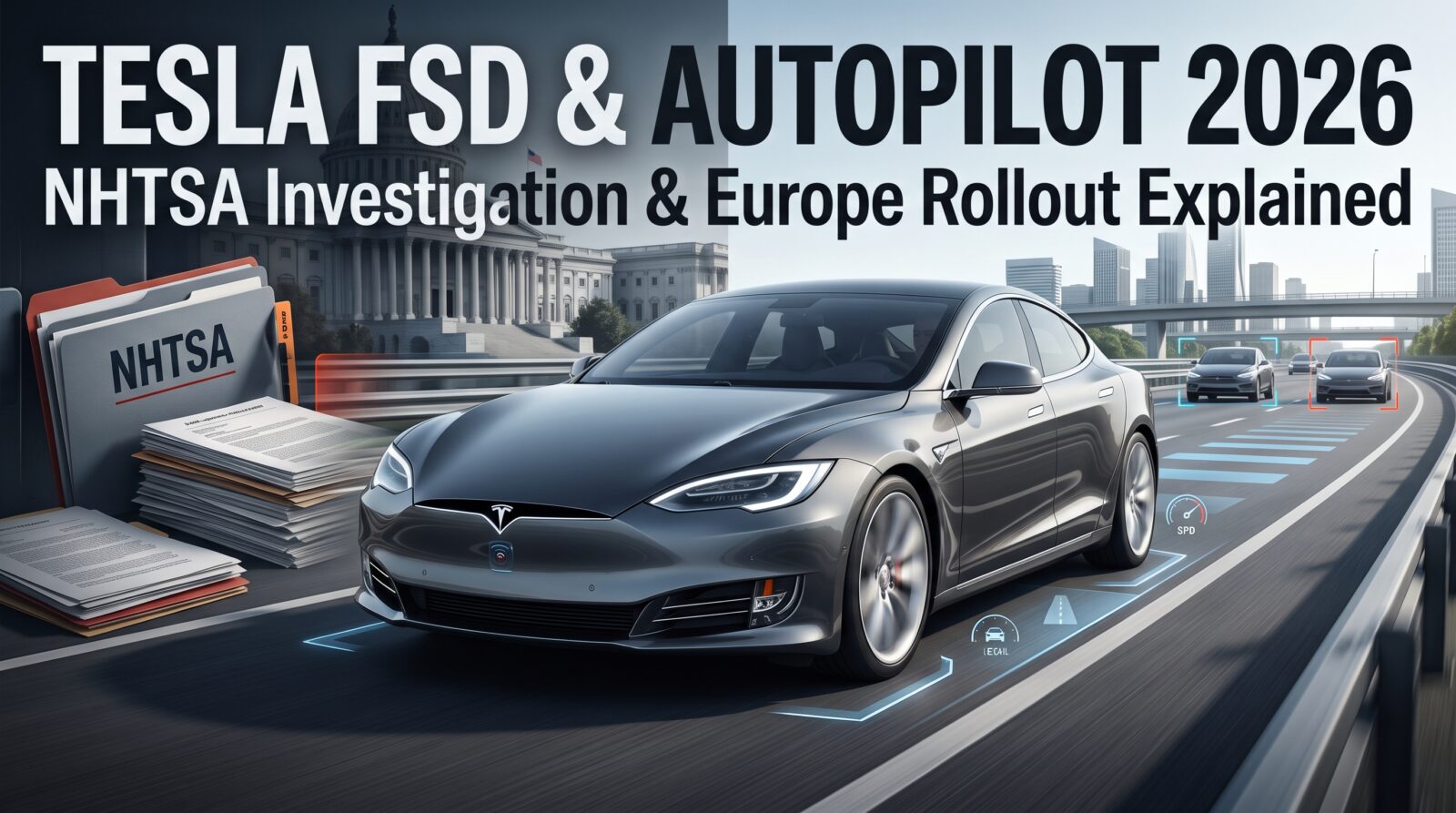
Tesla’s Full Self-Driving (FSD) program sits at an inflection point in 2026: expanding regulatory approval across Europe, an active NHTSA safety investigation covering nearly 2.9 million vehicles, and a robotaxi service in Austin now operating without safety monitors in the front seat. The gap between “supervised” driver-assistance software and the “unsupervised” autonomous system underpinning Tesla’s robotaxi ambitions remains the central fact investors and regulators alike are wrestling with.
The Two-Track Regulatory Reality
Tesla is navigating fundamentally different regulatory tracks depending on geography and product tier:
- Supervised FSD (requiring an attentive driver ready to take control) is currently available in the U.S., Canada, Puerto Rico, New Zealand, Australia, Mexico, and China, with roughly 1.3 million vehicles carrying FSD access globally.
- Unsupervised FSD — the software actually driving Tesla’s robotaxi fleet — remains on a separate, far more demanding regulatory track, since it requires demonstrating the system is safer than a human driver even in permissive states like Texas.
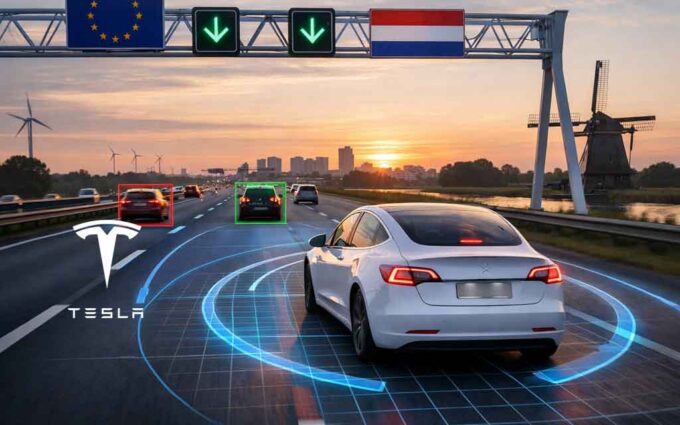
- Europe has been the slowest-moving major market. The Dutch vehicle authority (RDW) conducted an 18-month review before concluding supervised FSD is “safer than other driver assistance systems” due to continuous driver monitoring — a green light that other EU states can recognize via mutual exemption ahead of a bloc-wide vote. The relevant UN vehicle-regulation body (GRVA/WP.29) has been advancing “02-series” amendments that would formally codify when hands-off, system-initiated maneuvers are legal across the EU, with a harmonization vote anticipated around mid-2026.
Crucially, even a favorable EU vote on the 02-series amendments would not convert FSD into an unsupervised robotaxi system in Europe — that remains a distinct approval track, meaning Tesla’s European robotaxi ambitions trail its U.S. supervised-FSD rollout by a significant margin.
The NHTSA Investigation
U.S. safety regulators opened a formal investigation into FSD in October 2025, focused on documented incidents of vehicles running red lights, driving on the wrong side of the road, and colliding with other vehicles in ways that caused injuries. Key developments through 2026:
- NHTSA’s request for information covers approximately 2.88 million vehicles.
- Tesla received a five-week extension in mid-January 2026, pushing its data-submission deadline to February 23, 2026, and a further deadline of March 9, 2026 for full data disclosure.
- The investigation’s core question is not merely whether crashes occurred, but whether the deployed system complies with traffic laws and whether Tesla did enough to prevent foreseeable misuse of a system still branded “Full Self-Driving” despite requiring constant driver attentiveness.
- Analysts flagged the March 9 deadline as a share-price-relevant event, with TSLA trading in the $390–$407 range in the lead-up.
What Tesla’s Own Safety Data Shows
Tesla’s most-cited internal safety metric, drawn from its quarterly safety reports, compares crash frequency with and without Autopilot engaged:
| Driving Mode | Crash Frequency |
|---|---|
| Autopilot engaged | 1 crash per 5.94 million miles driven |
| Autopilot not engaged (Tesla vehicles) | 1 crash per 1.08 million miles driven |
Tesla and Elon Musk have repeatedly cited this roughly 5-to-6x gap as evidence the technology is already safer than unassisted human driving. Critics of this framing note the comparison is not adjusted for road type, driving conditions, or driver demographics — Autopilot is disproportionately used on highways, which have inherently lower crash rates than the urban and residential roads that make up a larger share of “Autopilot off” miles — meaning the raw multiple likely overstates the technology’s relative safety advantage.
Competitive Positioning
Tesla’s approach — a vision-only, camera-based system deployed at consumer scale across its existing fleet — remains a structural outlier against rivals:
- Waymo (Alphabet) uses a LiDAR-plus-camera sensor suite and has focused on a smaller number of geofenced, mapped cities rather than a broad consumer rollout, trading scale for a narrower but more thoroughly validated operating domain.
- Chinese competitors are moving quickly on adjacent capabilities — including battery-swap integration and driver-assist features tightly bundled with domestic robotaxi pilots — intensifying competitive pressure in a market where Tesla has already had to pause and restart FSD-adjacent software rollouts due to regulatory requirements.
- Tesla’s now-live Austin robotaxi service, which began in June 2025 with a safety monitor in the passenger seat and has since operated in some configurations without one, remains the closest real-world proof point for the unsupervised-FSD thesis that underlies a substantial share of Tesla’s long-term valuation narrative.
What to Watch Through the Rest of 2026
- NHTSA’s findings following the March 2026 data submission — any formal defect finding or recall order would be a materially negative catalyst distinct from the ongoing investigation itself.
- The EU’s WP.29/GRVA harmonization vote on 02-series amendments, which would streamline (but not complete) supervised-FSD approval across the bloc.
- China’s regulatory posture, where Tesla has previously had to halt software update deliveries pending additional approval, and where FSD-adjacent features remain more restricted than in the U.S.
- Robotaxi fleet expansion beyond Austin, and whether Tesla can scale unsupervised operations to additional U.S. cities without a comparable investigation being opened by state or federal regulators.
- Software revenue disclosure, since Musk has explicitly framed regulatory approval milestones (Europe, China) as demand drivers for FSD software attach rates amid slowing new-vehicle sales growth.
Bottom Line
Tesla’s FSD program is advancing on two fronts simultaneously and asymmetrically: incremental regulatory wins for supervised FSD in Europe and continued U.S. availability, set against an active, high-vehicle-count NHTSA safety investigation and a much longer runway before unsupervised, robotaxi-grade autonomy achieves broad regulatory approval outside a handful of U.S. states. Investors and regulators are effectively pricing two different products — supervised driver assistance, which is scaling now, and unsupervised autonomy, which remains the far larger but far less proven bet.


Leave a comment