

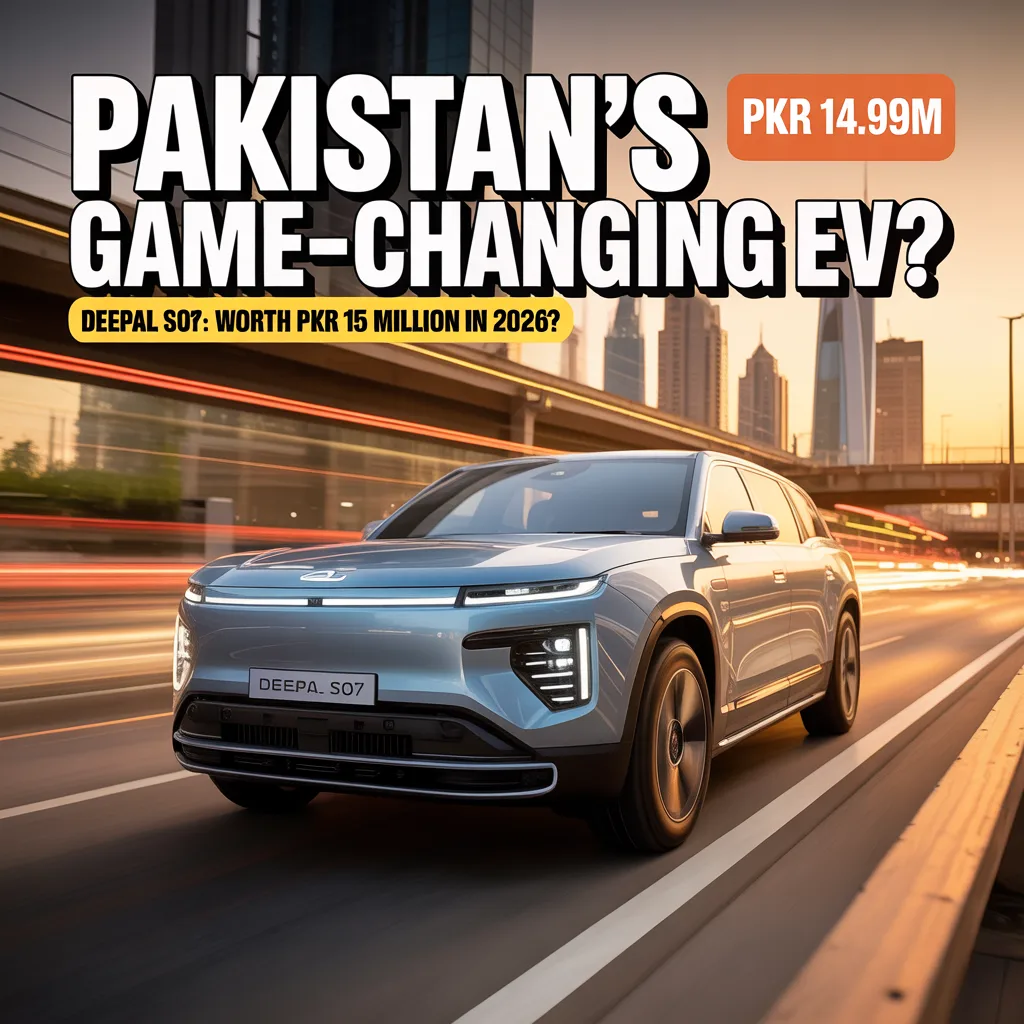

Pakistan’s automotive landscape is undergoing a seismic transformation. After decades dominated by internal combustion engines and a narrow palette of imports, the nation’s roads are witnessing an electric renaissance—one that promises not merely to disrupt established hierarchies but to fundamentally redefine what Pakistani consumers expect from their vehicles. At the vanguard of this revolution stands the Deepal S07, a sophisticated electric SUV from Changan’s premium sub-brand that has arrived with specifications, pricing, and ambitions bold enough to unsettle the status quo. With an ex-factory price of PKR 14,999,000 and a claimed range approaching 520 kilometers, this Chinese contender is positioning itself as the thinking person’s alternative to established names—a vehicle that eschews mere badge prestige for substantive engineering merit and genuine value proposition.
The timing could scarcely be more propitious. Pakistan’s government has extended import duty concessions for electric vehicles through 2026, while rising fuel costs and environmental consciousness have created fertile ground for battery-electric adoption among the urban affluent. Yet questions remain: Can the Deepal S07—a nameplate relatively unknown outside China—truly compete against the BYD Sealion 7, the venerable MG ZS EV, and even the aspirational Tesla Model Y? Does its technology justify the premium over conventional SUVs? And perhaps most crucially for Pakistan’s discerning buyers: Will this vehicle age gracefully in a market where after-sales support and resale value determine long-term satisfaction? This comprehensive review seeks to answer those questions with the rigor and nuance they deserve.
Origins and Market Context: Deepal’s Strategic Entry into Pakistan’s EV Frontier
To understand the Deepal S07, one must first appreciate its provenance. Deepal (known as Shenlan in China) emerged in 2022 as Changan Automobile’s answer to the premium electric vehicle segment, a strategic pivot by one of China’s “Big Four” state-owned automakers. While Changan has operated in Pakistan since 2018 through Master Changan Motors Limited—a joint venture with Master Motors—the Deepal marque represents something more ambitious: an attempt to leapfrog the brand’s commercial vehicle associations and compete directly with Tesla, BYD, and European luxury nameplates on technology and design merit.
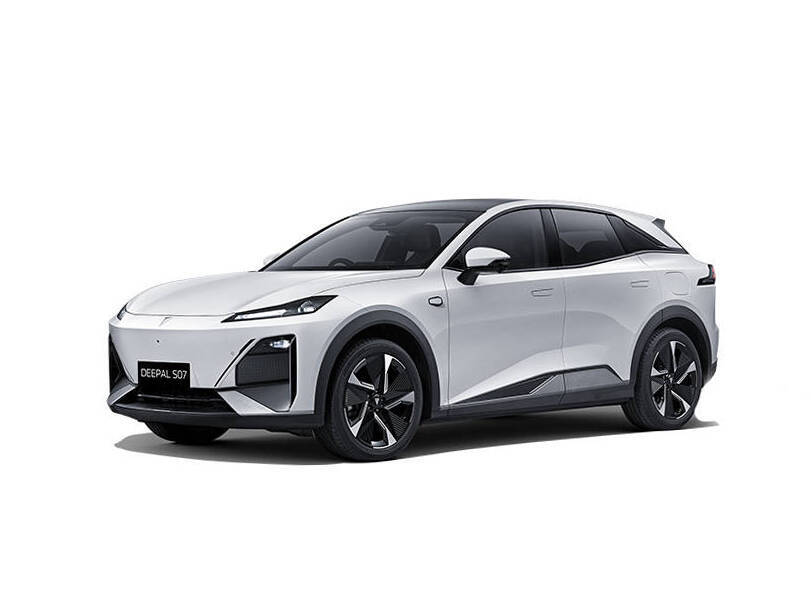
The S07 itself debuted in China in mid-2023, quickly becoming one of the bestselling electric SUVs in the hyper-competitive domestic market. Its arrival in Pakistan in late 2025—with deliveries accelerating through early 2026—coincides with a broader influx of Chinese EVs capitalizing on favorable import policies and infrastructure investment. PakWheels.com reports that EV registrations in Pakistan’s major cities have tripled year-over-year, driven primarily by Chinese brands offering compelling price-to-specification ratios that Japanese and Korean competitors struggle to match.
What distinguishes the Deepal S07 from competitors like the BYD Sealion 7 or Seres 7? Primarily, it’s positioning: neither entry-level nor ostentatiously luxurious, the S07 occupies a Goldilocks zone targeting professionals, entrepreneurs, and dual-income families seeking advanced technology without the six-figure price tags of European alternatives. At PKR 14,999,000, it undercuts the Audi e-tron by nearly half while offering comparable interior space and superior integrated technology—a value proposition that resonates in a market where purchasing power remains constrained despite growing EV enthusiasm.
Design and Exterior: Sculpted Confidence Without Ostentation
The Deepal S07’s exterior design philosophy could be characterized as “muscular minimalism”—a aesthetic that prioritizes clean surfacing and aerodynamic efficiency over ornamental excess. At 4,750 mm in length, 1,930 mm in width, and 1,625 mm in height, the S07 occupies the compact SUV segment with dimensions remarkably similar to the Tesla Model Y, yet its visual presence feels more grounded, less aggressive than its American counterpart.
Front Fascia and Lighting Architecture
The face is dominated by a blanked-off grille—now de rigueur in EV design—flanked by split-level LED headlights that incorporate Deepal’s distinctive “digital pulse” daytime running light signature. Unlike the overtly futuristic treatments seen on vehicles like the BYD Sealion 7, the S07’s frontal design reads as contemporary rather than avant-garde, a choice that should ensure aging gracefully. The lower air intake incorporates active grille shutters that close at highway speeds to optimize aerodynamic performance—a detail rarely mentioned in marketing materials but evident in the vehicle’s impressive 0.26 Cd drag coefficient.
Profile and Proportions
In profile, the S07 reveals its most compelling design elements: a rising shoulder line that creates visual momentum, flush door handles that retract when locked, and a gently sloping roofline that terminates in a substantial rear spoiler. The 19-inch or optional 20-inch wheels (depending on variant) fill the arches purposefully without appearing oversized. Camera-based side mirrors—a feature increasingly common on Chinese EVs but still rare elsewhere—reduce wind noise and improve efficiency, though their legality in all jurisdictions remains evolving.
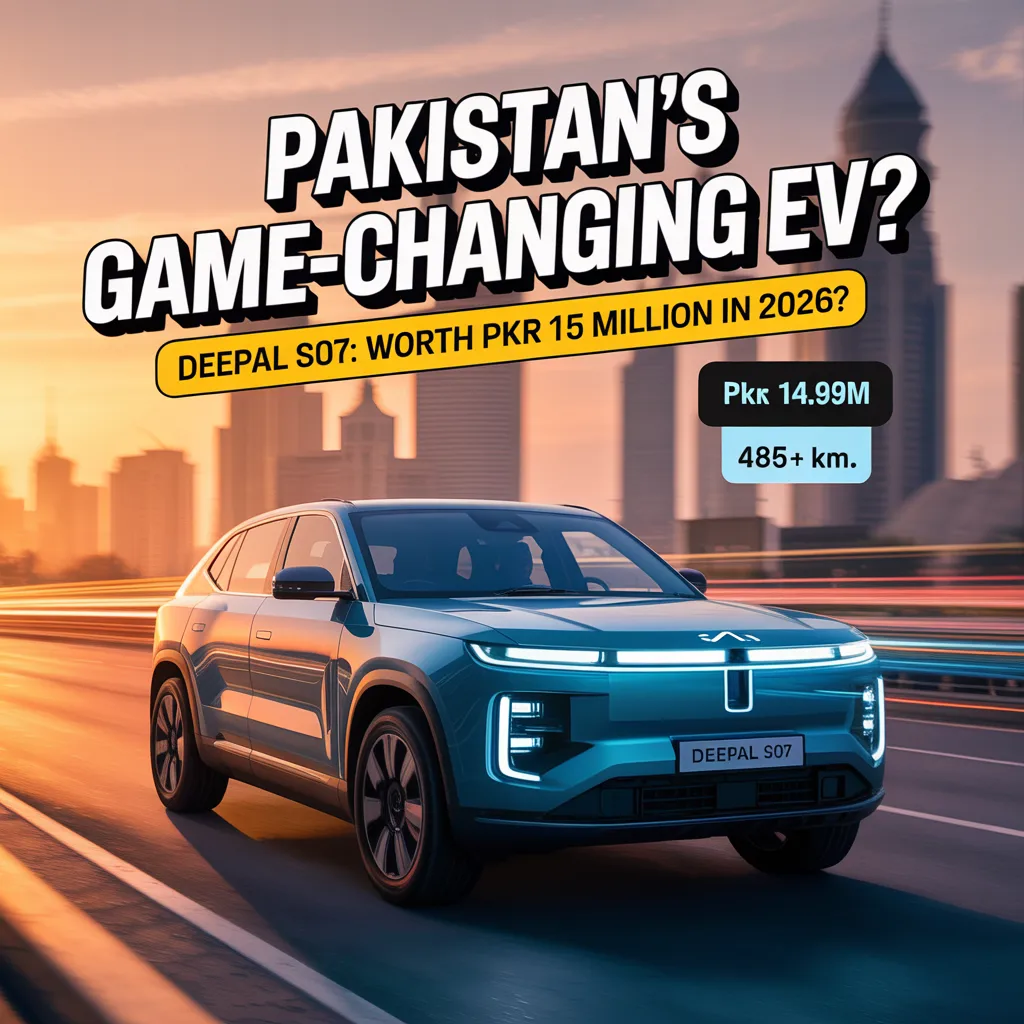
The overall stance conveys solidity rather than sportiness, a deliberate choice for a vehicle intended to transport families rather than lap circuits. Against competitors, the S07 appears more refined than the utilitarian MG ZS EV yet less overtly styled than the BYD Sealion 7, positioning it neatly between mass-market practicality and premium aspiration.
Rear Design and Aerodynamic Detailing
The rear treatment features full-width LED taillights—now almost compulsory in the segment—and a subtle diffuser element that manages airflow exiting beneath the vehicle. Badge placement is restrained: “Deepal” script on the tailgate, model designation on the lower right. It’s an approach that suggests confidence rather than insecurity, allowing the vehicle’s proportions to speak rather than relying on ostentatious branding.
Color options in the Pakistan market include Moonlight Silver, Obsidian Black, Pearl White, and Aurora Blue—a palette that skews conservative but aligns with local preferences and resale considerations. The paint quality, upon close inspection, reveals depth and consistency competitive with vehicles costing significantly more, evidence of Changan’s manufacturing investments.
Interior and Comfort: Where Deepal Makes Its Strongest Argument
Step inside the Deepal S07, and the rationale for its pricing becomes immediately apparent. This cabin represents a masterclass in value engineering—not in the pejorative sense of cost-cutting, but in delivering premium materials, thoughtful ergonomics, and technological sophistication typically reserved for vehicles costing twice as much.
Material Quality and Craftsmanship
The dashboard architecture is dominated by dual high-resolution displays—a 12.3-inch digital instrument cluster and a central 15.6-inch touchscreen mounted in portrait orientation—yet the interior avoids the sterile minimalism that has become Silicon Valley’s contribution to automotive design. Soft-touch surfaces predominate above the waistline, with convincing synthetic leather spanning the door panels and dashboard. Real aluminum trim accents provide visual relief without descending into gaudiness, while ambient lighting with 64-color customization creates atmosphere without gimmickry.
The seats—available in black or two-tone beige/black configurations—feature diamond-pattern stitching and power adjustment across eight directions for the driver (with memory function) and six for the front passenger. Ventilation and heating are standard, while massage functionality appears on higher trims. After hours behind the wheel, these seats prove supportive without excessive bolstering, accommodating various body types comfortably—a crucial consideration for vehicles intended for long-distance highway cruising on Pakistan’s improving but still-challenging road network.
Space, Ergonomics, and Practical Considerations
Rear passenger space is genuinely generous: at 2,900 mm, the wheelbase delivers legroom competitive with vehicles a class above, while the flat floor (enabled by battery packaging) means three adults can sit abreast without the central passenger straddling a transmission tunnel. Rear seat occupants benefit from dedicated climate vents, USB-C charging ports, and adjustable seatback angles—thoughtful touches that elevate the ownership experience for families.
Cargo capacity measures 520 liters with seats upright, expanding to 1,340 liters with rear seats folded—figures that trail the BYD Sealion 7 slightly but exceed the MG ZS EV substantially. The load floor is low and flat, with underfloor storage compartments and bag hooks that suggest actual design input from people who carry groceries, luggage, and the detritus of contemporary life.
Storage throughout the cabin is abundant: a generous center console bin, deep door pockets, cupholders positioned logically rather than as afterthoughts, and a wireless charging pad that actually secures phones rather than allowing them to slide during spirited driving. These details matter profoundly in daily use yet often receive insufficient attention in reviews fixated on 0-100 km/h times.
Technology Integration: Sophistication Without Complexity
The 15.6-inch Deepal OS touchscreen—powered by a Qualcomm Snapdragon 8155 chip—operates with fluidity approaching smartphone responsiveness, a marked improvement over the laggy interfaces plaguing many competitors. The operating system supports over-the-air updates, enabling continuous feature enhancement and bug fixes without dealership visits—a capability that will prove increasingly important as software defines vehicle competitiveness.
Voice control, localized for Pakistani English accents and Urdu commands, handles climate adjustment, navigation, media playback, and even sunroof operation with impressive accuracy. Apple CarPlay and Android Auto integration is wireless, though the native navigation system—with real-time traffic data for Karachi, Lahore, and Islamabad—often proves more current than smartphone alternatives.
The digital instrument cluster can be configured across multiple layouts, from traditional analog-inspired gauges to minimalist efficiency readouts. Information density is customizable without becoming overwhelming, striking a balance between data availability and cognitive load—a consideration especially important during the adaptation period as drivers transition from internal combustion conventions.
One minor critique: the haptic feedback for touchscreen controls sometimes registers inputs ambiguously, requiring visual confirmation that adjustments have registered. Physical buttons for climate control temperature and volume—retained when many competitors have eliminated them entirely—are ergonomic triumphs that deserve celebration.
Performance and Driving Experience: Silence, Smoothness, and Surprising Agility
Electric vehicles fundamentally alter automotive performance paradigms, and the Deepal S07 exploits this transformation masterfully. Available in single-motor rear-wheel-drive or dual-motor all-wheel-drive configurations (Pakistan currently receives the former), the S07 prioritizes refinement and efficiency over outright acceleration, though performance remains brisk by any conventional standard.
Powertrain Specifications and Real-World Performance
The single-motor variant produces 175 kW (235 hp) and 320 Nm of torque, sufficient to propel the S07 from standstill to 100 km/h in approximately 7.6 seconds—respectable rather than startling, but perfectly adequate for overtaking on highways and merging into traffic. More impressive is the instantaneous torque delivery characteristic of electric motors, which renders the S07 effortlessly responsive in urban contexts where conventional automatics lag perceptibly.
Regenerative braking can be adjusted across multiple levels, from minimal (coasting freely) to aggressive (one-pedal driving that brings the vehicle nearly to a complete stop when lifting off the accelerator). The calibration is superb: progressive, predictable, and natural-feeling, avoiding the abrupt deceleration that makes some EVs nauseating for passengers unaccustomed to regeneration. After acclimation, one-pedal driving becomes intuitive, reducing brake pedal use by approximately 80% in typical urban driving—extending brake component life dramatically.
Suspension, Handling, and Ride Quality
The S07 rides on a MacPherson strut front and multi-link rear suspension, tuned toward comfort rather than sportiness—an appropriate choice for Pakistan’s road conditions, which range from excellent new highways to deteriorating urban streets riddled with potholes and speed bumps. The suspension absorbs irregularities capably without feeling disconnected or wallowy, maintaining body control during spirited cornering while isolating occupants from road imperfections.
Steering weight is adjustable (Comfort, Standard, Sport), though differences are subtle and the middle setting proves ideal for most situations. The steering itself is accurate rather than communicative—you point, the S07 goes there, but feedback about surface conditions remains muted. For a family SUV, this feels appropriate; those seeking driver engagement may find the experience competent but uninvolving.
The low center of gravity—courtesy of underfloor battery placement—manifests in cornering stability that defies the S07’s 2,100 kg curb weight. Body roll is well-controlled, and the vehicle tracks confidently at highway speeds, requiring minimal steering corrections even when buffeted by crosswinds or disturbed by pavement irregularities.
Noise, Vibration, and Harshness (NVH)
Electric propulsion eliminates engine noise, allowing other sounds to become prominent: wind rush, tire roar, suspension impacts. Deepal has invested significantly in NVH mitigation, with acoustic glass, extensive sound deadening materials, and aerodynamic refinement yielding a cabin that remains conversational at 120 km/h. Road noise intrudes more noticeably on coarse asphalt, though remaining comparable to premium combustion SUVs costing considerably more.
The absence of mechanical vibration—no idling engine, no transmission shifts—contributes to a serene ambiance that proves particularly welcome during Karachi’s notorious traffic congestion. Passengers have repeatedly commented on the S07’s “expensive feel,” a subjective quality attributable largely to this absence of vibration and mechanical coarseness.
Technology and Safety: Advanced Driver Assistance Meets Pakistani Realities
The Deepal S07 arrives equipped with Advanced Driver Assistance Systems (ADAS) that, while not matching Tesla’s Autopilot or Mercedes’ Drive Pilot in sophistication, represent meaningful safety enhancements rarely available at this price point in Pakistan’s market.
Driver Assistance Features
Standard equipment includes:
- Adaptive Cruise Control (ACC): Maintains set speeds and following distances, functioning smoothly in highway contexts though occasionally confused by lane-splitting motorcycles common on Pakistani roads
- Lane Keeping Assist (LKA): Provides gentle steering corrections when drifting from lane markings, though poorly painted road lines limit effectiveness in many areas
- Automatic Emergency Braking (AEB): Includes pedestrian and cyclist detection, with forward collision warning providing audible and visual alerts
- Blind Spot Monitoring: Illuminates door mirror icons when vehicles occupy adjacent lanes, with rear cross-traffic alert active during reversing
- 360-degree Camera System: Four cameras provide bird’s-eye and split views during parking, with surprisingly high resolution and useful guidelines
These systems function reliably when conditions allow—well-marked highways, moderate traffic, good visibility—but struggle with scenarios unique to developing markets: unmarked rural roads, chaotic urban intersections, livestock sharing roadways. The vehicle makes no claims toward autonomous capability, positioning these features appropriately as assistance rather than automation.
Passive Safety and Structural Integrity
The S07’s body structure incorporates high-strength steel in key load paths, with frontal crumple zones designed to absorb impact energy while maintaining cabin integrity. While the vehicle has not undergone NCAP crash testing in Western jurisdictions, Changan cites compliance with Chinese C-NCAP protocols, which have become increasingly stringent. Six airbags come standard (front, side, curtain), with higher variants offering eight.
Battery protection receives particular attention: the lithium iron phosphate (LFP) or ternary lithium pack (depending on variant) sits within a reinforced aluminum enclosure with multiple collision sensors that disconnect high-voltage systems within milliseconds of impact detection. Thermal management systems monitor individual cell temperatures, with active cooling preventing the thermal runaway events that have plagued earlier-generation EVs.
Battery, Range, and Charging: The Practical Realities of EV Ownership in Pakistan
For all the discussion of performance and features, battery capacity and charging infrastructure remain the determinative factors in EV practicality—particularly in Pakistan, where charging networks remain nascent compared to developed markets.
Battery Specifications and Chemistry
The Deepal S07 offers two battery options in its home market, though Pakistan currently receives primarily the larger variant:
- 66.8 kWh: LFP chemistry, CLTC range ~520 km, optimized for cost and longevity
- 79.8 kWh: Ternary lithium (NCM), CLTC range ~620 km, prioritizing energy density (availability in Pakistan remains uncertain)
Pakistani market vehicles feature the 66.8 kWh LFP pack, with Deepal claiming a WLTP-equivalent range of approximately 485 kilometers—a figure more conservative and realistic than CLTC certification would suggest. Independent testing by PakWheels.com documented 440-460 km in mixed driving (60% highway, 40% urban) with climate control in moderate use, while highway-only driving at 100-110 km/h consistently delivered 400+ km.
These figures position the S07 competitively: exceeding the MG ZS EV (320 km) substantially, roughly matching the BYD Sealion 7 (460-530 km depending on variant), and approaching but not reaching the Tesla Model Y Long Range (533 km).
Real-World Range Considerations
Range remains context-dependent. Factors degrading efficiency include:
- Climate control: Air conditioning at maximum cooling can reduce range by 15-20% in Karachi’s summer heat
- Driving style: Aggressive acceleration and high-speed cruising (130+ km/h) substantially impact consumption
- Terrain: Mountainous routes to northern regions reduce range significantly during ascent, though regenerative braking recovers substantial energy during descent
- Battery temperature: Extreme heat or cold reduces chemical efficiency, though Pakistan’s climate generally proves favorable
For typical Pakistani use cases—urban commuting, weekend highway trips, occasional intercity travel—the S07’s range proves adequate, providing genuine 400+ km capability that covers Karachi-Hyderabad, Lahore-Islamabad, or daily urban driving for a week between charges.
Charging Infrastructure and Practicalities
The S07 supports AC charging at 11 kW (adding ~50 km range per hour) and DC fast charging up to 150 kW (10-80% in approximately 30 minutes under ideal conditions). Pakistan’s charging infrastructure, while expanding, remains concentrated in major urban centers:
- Home charging: 220V domestic outlets provide 2-3 kW (overnight replenishment), while dedicated 7-11 kW wallboxes enable 6-8 hour full charges
- Public AC charging: Shopping malls, hotels, and dedicated stations in Karachi, Lahore, Islamabad offer 7-22 kW
- DC fast charging: Shell Recharge, Total Energies, and Pakistan Petroleum Limited are deploying 50-150 kW stations on major highways, though gaps remain
For prospective buyers, home charging capability is essentially mandatory. Those residing in apartments without dedicated parking face significant challenges, as building-installed infrastructure remains rare. The ability to depart each morning with a “full tank” represents EVs’ primary convenience advantage—negating fuel station visits—but requires appropriate electrical capacity and off-street parking.
Battery Longevity and Warranty
Deepal provides an 8-year/150,000 km warranty on the battery pack, guaranteeing 70% capacity retention—standard in the industry and reflecting LFP chemistry’s superior cycle life compared to ternary lithium. Changan’s after-sales network in Pakistan includes battery diagnostic capabilities at authorized service centers in major cities, though long-term parts availability remains unproven given the brand’s relatively recent market entry.
Pricing and Ownership Costs: Value Proposition Dissected
At PKR 14,999,000 ex-factory, the Deepal S07 occupies a fascinating market position—expensive compared to conventional SUVs like the Hyundai Tucson (PKR 8-10 million) but substantially cheaper than European electric alternatives like the Audi e-tron (PKR 28+ million) while undercutting even the BYD Sealion 7 (PKR 15.5-17 million depending on variant).
Price Breakdown and Variant Availability
Current Pakistan pricing (January 2026):
| Variant | Ex-Factory Price | On-Road Price (Est.) |
|---|---|---|
| S07 Premium EV | PKR 14,999,000 | PKR 15,300,000-15,500,000 |
On-road costs include registration, number plates, and token tax, though EVs benefit from reduced registration fees and exemption from certain levies under Pakistan’s 2020-2026 EV policy. Insurance premiums run 3-4% of vehicle value annually, comparable to conventional vehicles.
Total Cost of Ownership Analysis
EV ownership economics differ fundamentally from combustion vehicles. Consider a typical 15,000 km annual driving scenario:
Operating Costs (Annual)
- Electricity (assuming 18 kWh/100 km, PKR 25/kWh off-peak home charging): ~PKR 67,500
- Maintenance (minimal; no oil changes, fewer brake replacements): ~PKR 15,000-25,000
- Insurance: ~PKR 550,000-600,000
- Token tax: Reduced EV rate ~PKR 30,000
Annual total: ~PKR 665,000-725,000
Compare this to a conventional SUV:
- Fuel (12 L/100 km, PKR 280/L): ~PKR 504,000
- Maintenance: ~PKR 60,000-80,000
- Insurance: ~PKR 400,000-450,000
- Token tax: ~PKR 80,000-100,000
Annual total: ~PKR 1,044,000-1,134,000
The S07 saves approximately PKR 380,000-410,000 annually in operating costs—meaningful but insufficient to justify purchase purely on economic grounds given the higher acquisition cost. The calculation shifts favorably for high-mileage users (taxis, corporate fleets) or those valuing environmental and performance benefits beyond pure financial optimization.
Resale Value Considerations
Resale remains the great unknown. Pakistan’s used EV market lacks sufficient history to establish depreciation curves, while rapid technological advancement risks rendering earlier models obsolete. Conventional wisdom suggests steeper initial depreciation than combustion vehicles, offset somewhat by lower running costs and growing buyer acceptance. Battery degradation fears—often exaggerated—nonetheless influence buyer psychology, potentially depressing resale values unfairly.
Deepal S07 vs. Competitors: A Comparative Analysis
Understanding the S07’s market position requires direct comparison with alternatives. The following analysis examines key competitors across critical dimensions:
Detailed Comparison Table
| Specification | Deepal S07 | BYD Sealion 7 | MG ZS EV | Tesla Model Y (RWD) |
|---|---|---|---|---|
| Price (PKR) | 14,999,000 | 15,500,000-17,000,000 | 8,500,000-9,500,000 | 22,000,000+ (limited availability) |
| Battery (kWh) | 66.8 | 71.8-82.5 | 50.3 | 60 (approx.) |
| Range (WLTP km) | ~485 | 460-530 | 320 | 455 |
| Power (kW/hp) | 175/235 | 170-230/230-308 | 130/177 | 220/299 |
| 0-100 km/h (sec) | 7.6 | 6.7-4.5 | 8.6 | 6.9 |
| Charging (DC kW) | 150 | 150-230 | 76 | 250 |
| Infotainment Screen | 15.6″ | 15.6″ rotating | 10.1″ | 15.4″ |
| Warranty (years/km) | 5/150,000; Battery 8/150,000 | 6/150,000; Battery 8/150,000 | 5/100,000; Battery 8/150,000 | 4/80,000; Battery 8/192,000 |
| ADAS Features | ACC, LKA, AEB, 360 cam | ACC, LKA, AEB, 360 cam, parking assist | ACC, AEB, limited | Autopilot (enhanced) |
Competitive Positioning Analysis
vs. BYD Sealion 7: The closest competitor in price and capability. The Sealion 7 offers slightly better performance in higher trims and BYD’s established reputation in battery technology, but the Deepal S07 counters with superior interior material quality, more refined driving dynamics, and marginally lower pricing. BYD’s more extensive dealer network in Pakistan currently provides an after-sales advantage, though both brands remain relatively new to the market. The choice often reduces to brand preference and specific feature priorities.
vs. MG ZS EV: The MG represents budget-conscious EV entry, costing PKR 5-6 million less than the S07. However, compromises are substantial: significantly reduced range (~320 km vs. 485 km), less sophisticated interior, slower charging, and notably inferior technology integration. The ZS EV suits price-sensitive buyers or those with shorter daily ranges; the S07 targets those valuing refinement and capability, justifying the premium through tangible improvements across nearly every dimension.
vs. Tesla Model Y: Where available in Pakistan (primarily through gray imports), the Model Y commands PKR 22+ million—nearly 50% more than the S07. Tesla offers superior charging infrastructure access globally, more advanced autonomy features, and stronger brand cachet. However, the price differential is staggering, and Deepal’s interior quality, standard equipment levels, and build solidity narrow gaps significantly. The Model Y remains aspirational for many; the S07 delivers 80-85% of the experience for 65% of the cost.
vs. European Alternatives (Audi e-tron, BMW iX3): These command PKR 28-35 million in Pakistan, targeting an entirely different buyer segment. While badge prestige and established dealer networks provide reassurance, the Deepal S07 challenges whether that reassurance merits double the expenditure—particularly when technology, range, and features often favor the Chinese upstart.
Pros and Cons: An Honest Assessment
Strengths Worth Celebrating
Exceptional Value Engineering: The S07 delivers premium materials, technology, and refinement at a price point historically associated with mid-market offerings—a genuine democratization of EV luxury.
Impressive Real-World Range: The conservative 485 km WLTP claim translates to genuine 400+ km usability in varied conditions, alleviating range anxiety for most use cases.
Interior Quality and Space: The cabin rivals vehicles costing twice as much, with generous space, thoughtful ergonomics, and premium materials throughout.
Technology Integration: The Snapdragon-powered infotainment operates with smartphone fluidity, OTA updates ensure continuous improvement, and ADAS features provide meaningful safety enhancements.
Refinement and NVH: Exceptional quietness and ride quality establish benchmark standards in the segment.
Operating Economics: Dramatic reductions in fuel and maintenance costs deliver tangible ownership savings.
Limitations Requiring Acknowledgment
Brand Recognition: Deepal remains unknown outside China, potentially impacting resale values and buyer confidence despite Changan’s century-long automotive heritage.
After-Sales Network: While expanding, Changan’s service network in Pakistan remains less extensive than established brands, with long-term parts availability unproven.
Charging Infrastructure Dependency: The S07’s utility relies heavily on home charging capability and continued public infrastructure expansion—factors outside buyers’ control.
Performance Enthusiast Considerations: While competent, the S07 prioritizes efficiency and comfort over outright performance, potentially disappointing those seeking Tesla-like acceleration.
Software Localization: Voice control and navigation show occasional hiccups with Pakistani accents and local points of interest, though OTA updates continue improving recognition.
Resale Uncertainty: Pakistan’s nascent used EV market makes future value difficult to predict, introducing financial risk absent in established segments.
The Verdict: A Compelling Case for Electrification, With Caveats
The Deepal S07 represents something more significant than another electric SUV competing for Pakistani buyers’ attention—it embodies the maturation of China’s automotive industry and the democratization of technologies once reserved for luxury nameplates. At PKR 14,999,000, this vehicle delivers interior quality, space, technology, and refinement that fundamentally challenge established price-to-value relationships in Pakistan’s automotive market.
For the appropriate buyer—urban professionals with home charging capability, families seeking spacious transport with minimal operating costs, early adopters valuing technology over badge prestige—the S07 presents a compelling proposition. The 485 km range proves genuinely sufficient for typical Pakistani use cases, the cabin remains comfortable across long distances, and the refinement consistently impresses passengers unaware of the vehicle’s price point.
Yet prudence demands acknowledging limitations. Deepal’s brand novelty introduces risks around resale values and long-term parts availability that established nameplates avoid. Pakistan’s charging infrastructure, while improving, remains insufficient for anxiety-free intercity travel without advance planning. And the S07’s competent-but-uninvolving driving dynamics may disappoint those seeking emotional engagement rather than mere transportation efficiency.
Perhaps most significantly, the S07 succeeds by refusing to compromise. Where competitors cut corners to hit price targets—cheaper interiors, smaller batteries, inferior technology—Deepal invests in the elements that define daily ownership satisfaction. The result is a vehicle that feels thoughtfully engineered rather than cynically assembled, one that respects buyers’ intelligence by delivering substance over marketing hyperbole.
Pakistan’s electric vehicle transition remains nascent, with EVs representing barely 1% of new registrations despite government incentives and growing environmental consciousness. The Deepal S07 cannot single-handedly accelerate this transition, but it removes common objections—insufficient range, compromised luxury, questionable value—that have hindered adoption. By proving that electric SUVs can be simultaneously practical, refined, and relatively affordable, the S07 establishes a new baseline for what Pakistani consumers should expect from battery-electric mobility.
The ultimate question transcends specifications and pricing: Does the Deepal S07 deserve consideration alongside established alternatives? Unequivocally, yes. Whether it deserves your money depends on priorities: value those seeking badge prestige over engineering merit, or require extensive dealer networks for peace of mind, will find better fits elsewhere. But for those prioritizing tangible quality, technological sophistication, and operating economics—those willing to embrace a brand on merit rather than reputation—the S07 delivers an exceptionally compelling proposition.
As Pakistan’s roads gradually electrify, the Deepal S07 will be remembered not as a footnote but as evidence that the future of mobility arrives not from established capitals but from manufacturers willing to challenge conventions, invest in genuine quality, and trust that discerning buyers recognize value when presented honestly. In an automotive landscape too often dominated by badge snobbery and artificial scarcity, that represents something worth celebrating—and perhaps, for the right buyer, worth purchasing.
Sources and Further Reading:
- PakWheels.com – Pakistan’s leading automotive portal with comprehensive EV coverage and local market insights
- CarMagazine.co.uk – International automotive reviews and analysis
- Electrifying.com – Specialist EV reviews and charging infrastructure data
- TopGear.com – Global automotive journalism and vehicle comparisons



Leave a comment