

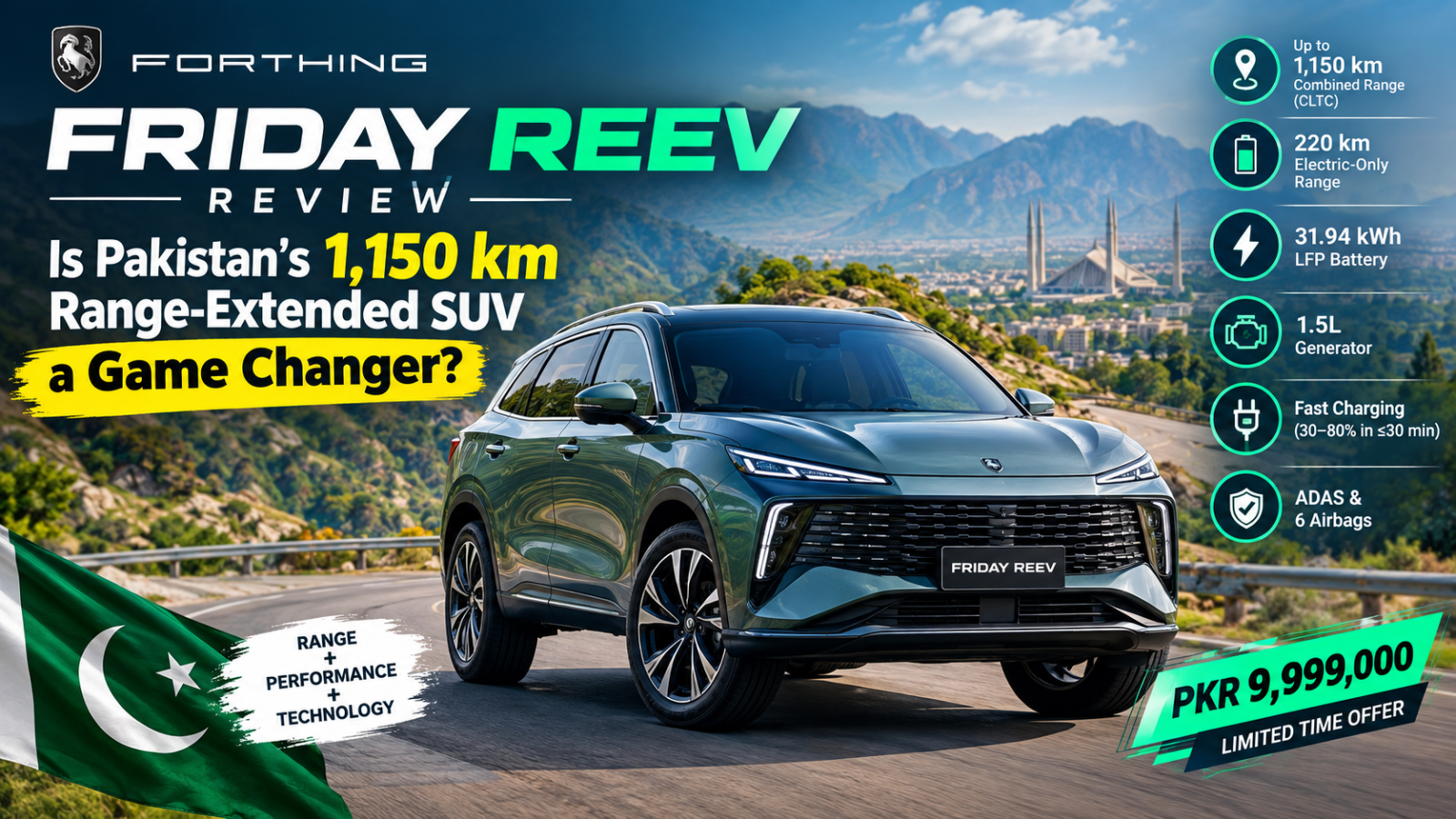

Pakistan’s electric-vehicle market is moving beyond the conventional choice between a pure battery-electric vehicle and a petrol-powered car. The Forthing Friday REEV represents a different approach: electric propulsion for the wheels combined with a petrol-powered range extender that generates electricity when additional range is required.
According to the product specification supplied by the manufacturer/importer, the Friday REEV Exclusive is being offered in Pakistan at a limited-time price of PKR 9,999,000. Its headline specification is an advertised combined range of up to 1,150 km under the CLTC cycle, while its electric-only range is approximately 220 km according to the supplied product sheet.
But the interesting question is not simply whether the Friday can claim 1,150 km. The more important question is how its REEV architecture fits the realities of driving an electrified SUV in Pakistan.
What Exactly Is the Forthing Friday REEV?
REEV stands for Range-Extended Electric Vehicle.
Unlike a conventional hybrid, where the petrol engine can mechanically contribute to driving the wheels, a REEV is designed around electric propulsion. The electric motor provides the drive, while the internal-combustion engine functions primarily as a generator to provide additional electrical energy.
That distinction is important because the Friday REEV is designed to retain the characteristics of an electric vehicle while reducing the dependence on charging infrastructure during long journeys.
Independent automotive coverage of the Friday explains the architecture in similar terms: the wheels are driven electrically, while the petrol engine operates as a generator rather than directly powering the wheels.
For Pakistan, where public EV charging infrastructure is still developing, this configuration addresses one of the most frequently discussed practical issues surrounding EV ownership: long-distance range management.
1,150 km Range: What Does It Really Mean?
The biggest headline attached to the Friday REEV is its up to 1,150 km combined range.
The supplied specification sheet identifies this as a CLTC combined-range figure.
CLTC is a standardized test cycle, so the number should primarily be viewed as a laboratory comparison figure rather than a promise that every driver will achieve 1,150 km in everyday conditions.
Real-world results can be affected by:
- Highway speed
- Traffic conditions
- Ambient temperature
- Air-conditioning use
- Passenger and luggage load
- Road gradients
- Driving style
- Battery state of charge
- Fuel quality and operating conditions
The International Energy Agency has similarly highlighted the broader trade-off between vehicle range, battery size, weight and cost. Larger batteries can increase range, but they also add weight and expense.
The REEV approach takes a different route. Instead of carrying an exceptionally large battery, the Friday uses a comparatively compact 31.94 kWh LFP battery and combines it with a petrol range extender and 43-litre fuel tank.
Electric-Only Driving
The Friday REEV’s specification sheet lists an electric-only range of approximately 220 km.
This is potentially significant for urban users.
For many daily commutes, school runs, shopping trips and city driving, an electric-only range in this territory can allow substantial routine driving without using the petrol range extender.
The result is a two-part ownership proposition:
Short daily journeys: primarily electric driving.
Long-distance journeys: electric propulsion remains central, while the range extender provides additional energy when required.
That is fundamentally different from simply buying a large petrol SUV and relying on its fuel tank for long-distance range.
Battery and Powertrain
The Friday REEV uses a 31.94 kWh Lithium Iron Phosphate (LFP) battery. LFP chemistry has become increasingly important in the EV industry because of its combination of durability, safety characteristics and cost advantages compared with some alternative lithium-ion chemistries.
The supplied specification lists a 1.5-litre naturally aspirated engine as the generator and a permanent-magnet synchronous motor for propulsion. The electric motor is rated at 120 kW, with maximum torque of 240 Nm.
The vehicle uses rear-wheel drive, another interesting characteristic for an SUV in this segment.
The combination should provide the immediate torque response associated with electric propulsion while retaining the practicality of a fuel-supported range-extender system.
Charging: Designed for Both Home and Fast Charging
Charging remains an important part of the ownership equation.
According to the supplied specification sheet, AC charging from 0 to 100% takes approximately seven hours, while DC fast charging from 30% to 80% can take 30 minutes or less, subject to charging conditions and equipment.
This means an owner with access to overnight home charging could potentially begin most days with a replenished battery.
Fast charging becomes more relevant during longer journeys, although the REEV architecture provides an additional layer of flexibility because the vehicle is not completely dependent on finding a charger once the battery is depleted.
Technology and Cabin Equipment
The Friday REEV is not positioned simply as an efficiency-focused vehicle.
The supplied specification includes a 14.6-inch infotainment display and 8.8-inch digital cluster, along with 50W wireless charging and six speakers.
The equipment list places the vehicle within the technology-focused side of Pakistan’s emerging premium EV market.
For buyers considering an electrified SUV, these features matter because the EV experience increasingly includes the digital interface, connectivity and driver-assistance ecosystem rather than just the powertrain.
ADAS and Safety
Safety technology is another significant component of the Friday REEV package.
The supplied specification lists:
- Adaptive Cruise Control (ACC)
- Lane Keeping Assist (LKA)
- Automatic Emergency Braking (AEB)
- Forward Collision Warning (FCW)
- Blind Spot Detection (BSD)
- 360-degree surround-view camera
- Six airbags
- ISOFIX child-seat mounting
These systems can assist the driver, but they should not be interpreted as autonomous driving. ADAS technologies are designed to support the driver rather than eliminate the need for attentive human control.
Dimensions and Road Presence
At 4,600 mm long, 1,860 mm wide and 1,680 mm high, with a 2,715 mm wheelbase, the Friday sits firmly in the modern SUV/crossover category. The specification also lists 235/55 R19 tyres, giving the vehicle a substantial road presence.
For Pakistani buyers, the dimensions provide a useful balance between SUV presence and urban usability, although buyers should consider parking space and maneuverability in congested city environments.
Ownership and Warranty
The supplied product sheet provides a five-year/150,000 km vehicle warranty and an eight-year/160,000 km battery warranty.
Battery warranty is particularly important for an electrified vehicle because the battery represents one of its most valuable components.
For prospective buyers, however, the warranty should be evaluated alongside the official terms and conditions, including what constitutes battery degradation, which components are covered and how warranty claims are handled.
The Pakistan Factor
The Friday REEV arrives at an interesting moment for Pakistan’s automotive market.
The country’s EV transition is developing while consumers continue to face practical concerns surrounding charging availability and long-distance travel.
Pakistan’s Federal Board of Revenue has also formally examined the tariff classification of range-extended electric vehicles, including the Forthing Friday REEV, demonstrating that REEVs have become a distinct category within the country’s evolving automotive landscape.
Capital Smart Motors describes the Friday as Pakistan’s first range-extended electric vehicle model.
This makes the Friday more than another new SUV launch. It is part of a broader shift toward alternative electrified powertrain technologies in Pakistan.
What Makes the Friday REEV Different?
The strongest argument for the Friday REEV is the combination of three characteristics:
Electric propulsion + meaningful electric-only range + petrol-supported long-distance capability.
A conventional BEV depends entirely on its battery and charging network.
A conventional petrol SUV depends primarily on fuel.
A traditional hybrid can combine mechanical and electric propulsion.
The REEV occupies a different space by using the electric motor as the central propulsion system while using the petrol engine as a range extender.
That distinction could make the concept particularly relevant in markets where EV adoption is increasing faster than charging infrastructure.
Potential Advantages
The Friday REEV’s specification creates several potentially attractive ownership characteristics.
1. Reduced range anxiety
The advertised combined range of up to 1,150 km gives the vehicle a significant long-distance range buffer under the stated testing methodology.
2. Everyday electric driving
The approximately 220 km electric-only specification can cover many routine urban journeys without requiring petrol operation.
3. Smaller battery than a long-range BEV
The 31.94 kWh battery avoids the need for an exceptionally large battery pack while the generator provides additional range.
4. Fast charging capability
The specification lists DC charging from 30% to 80% in 30 minutes or less under suitable conditions.
5. Advanced driver assistance
ACC, LKA, AEB, FCW and BSD provide a relatively comprehensive driver-assistance package.
What Buyers Should Consider Carefully
The Friday REEV also deserves a realistic evaluation rather than being judged purely by its headline range.
Real-world range
The 1,150 km figure is a test-cycle claim. Actual results will vary.
Charging access
Even though the range extender provides additional flexibility, regular home charging remains valuable if the owner wants to maximize electric driving.
Service and parts network
For any relatively new automotive brand or technology in Pakistan, buyers should investigate dealership coverage, parts availability, technician support and warranty procedures before purchase.
Resale value
The long-term resale market for newer REEV technology in Pakistan is still developing. Buyers should therefore consider ownership horizon rather than assuming today’s market conditions will remain unchanged.
Technology learning curve
Consumers moving from conventional petrol cars to a REEV may need some time to understand charging, battery management, regenerative behavior and the operation of the range extender.
Price Positioning
The supplied Friday REEV brochure lists a limited-time price of PKR 9,999,000.
Recent Pakistani automotive coverage has also reported the PKR 9.99 million price point following earlier launch pricing around PKR 10.999 million.
For prospective buyers, the relevant figure should always be the current authorized-dealer price at the time of booking, because promotional pricing, taxes, registration and other on-road costs can change.
Final Verdict: A Different Route to EV Adoption
The Forthing Friday REEV is interesting because it does not ask Pakistani consumers to choose between electric driving and long-distance flexibility.
Instead, it attempts to combine the two.
Its 31.94 kWh LFP battery, 120 kW electric motor, 240 Nm torque, rear-wheel drive, approximately 220 km electric-only range and advertised 1,150 km CLTC combined range create a powertrain package aimed at buyers who want an electric driving experience without relying exclusively on public charging infrastructure.
The most important caveat is equally clear: 1,150 km is a claimed test-cycle figure, not a guaranteed real-world distance.
For Pakistani motorists, the Friday REEV therefore represents an emerging middle ground in the country’s automotive transition. It combines battery-electric driving for everyday mobility with a petrol generator for longer journeys.
Whether that formula becomes mainstream will depend not only on specifications, but also on real-world fuel economy, battery performance, service support, charging infrastructure, spare-parts availability, resale values and long-term ownership experience.
For now, the Friday REEV stands out as one of the more distinctive attempts to make long-range electrified driving practical for Pakistan’s evolving automotive market.



Leave a comment