


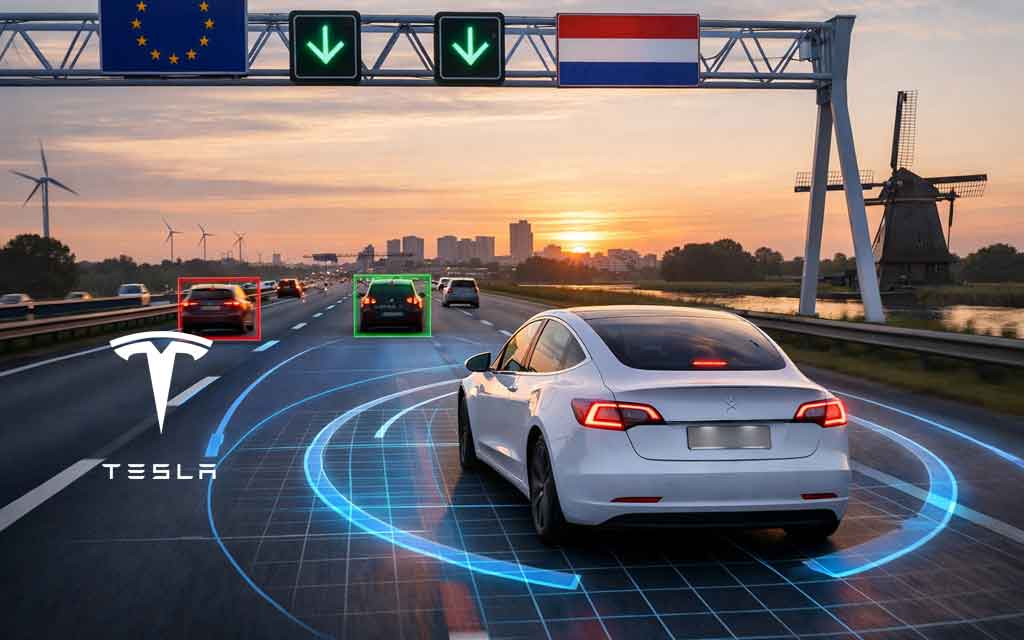
Tesla’s Full Self-Driving (FSD) Supervised software faces mounting scrutiny across Europe following comprehensive real-world testing in Belgium that revealed significant traffic safety violations. Conducted to evaluate the readiness of Tesla’s autonomous driving suite for European roads, the trial documented repeated speed limit breaches, dangerous maneuver attempts around cyclists, and confusion over localized traffic conventions.
These findings highlight the stark operational and regulatory divide between North American roadways and Europe’s tightly regulated urban environments, raising fresh questions about Tesla’s timeline for a broader European rollout.
Breakdown of the Belgian Road Test Findings
The Belgian field tests evaluated Tesla’s latest FSD software build on diverse road layouts, ranging from high-speed motorways to dense urban zones with heavy pedestrian and cycle traffic. Independent testers from European consumer watchdog groups monitored the vehicle’s telemetry and driver intervention rates.
1. Persistent Speeding Violations
During urban and sub-urban routes, the system consistently failed to adhere to dynamic and static speed limits. The vehicle repeatedly exceeded posted speed caps—including strict 30 km/h (18.6 mph) neighborhood zones—requiring immediate driver intervention to prevent legal infractions and safety risks. Telemetry revealed that while the vehicle occasionally recognized updated speed signage, it lagged in applying proportional braking, particularly when transitioning from high-speed corridors to restricted zones.
2. Prohibited Overtaking of Cyclists
Belgium maintains stringent traffic laws protecting vulnerable road users, including mandatory minimum lateral clearance distances (typically 1 to 1.5 meters) and outright bans on passing cyclists in designated bike lanes or near intersections. In multiple test instances, Tesla’s FSD attempted non-compliant overtakes across solid single white lines and squeezed past cyclists without maintaining statutory side margins.
3. Misinterpretation of European Road Geometry
The autonomous system struggled with several structural quirks of European roads:
- Priority from the Right (Priorité à droite): The software repeatedly failed to yield to vehicles entering from right-hand side streets at unmarked intersections.
- Complex Roundabouts: Multi-lane roundabouts caused lane hesitation, improper indicator signaling, and sudden unexpected braking maneuvers.
- Separated Cycle Infrastructure: The vision-only system frequently misclassified physically segregated bike tracks as drivable shoulders or adjacent traffic lanes.
European Infrastructure vs. American FSD Vision Architecture
Tesla’s end-to-end neural network architecture has been trained primarily on billions of miles of North American driving data. While effective on wide grid systems and standardized lane markings in the United States, this reliance creates operational friction when deployed on European soil.
+------------------------------------+------------------------------------+
| North American Traffic Context     | European Urban Traffic Context     |
+------------------------------------+------------------------------------+
| Wide, multi-lane road design       | Narrow, historic lane layouts      |
| Grid-based intersection geometry   | Irregular intersections & plazas   |
| Standardized signal placement      | Dynamic overhead & curb signals    |
| Cyclists usually in shared lanes   | Segregated bike highways & tracks  |
+------------------------------------+------------------------------------+
According to technical analysis published by Reuters, European driving environments require higher spatial resolution for micro-interactions, such as yielding to tramways and navigating narrow cobblestone lanes where lane lines are absent.
The Regulatory Barrier: UNECE vs. US NHTSA Frameworks
Tesla faces structural regulatory challenges in Europe that extend beyond software performance. While the U.S. National Highway Traffic Safety Administration (NHTSA) allows self-certification with post-market oversight, the European Union enforces a strict pre-market approval framework overseen by the United Nations Economic Commission for Europe (UNECE).
  [Tesla FSD Neural Net]
            │
            ▼
 ┌──────────────────────┐
 │ European Regulatory  │
 │     Filter           │
 └──────────┬───────────┘
            ├───────────────────────────────┐
            ▼                               ▼
 ┌──────────────────────┐        ┌──────────────────────┐
 │ UNECE DCAS Standards │        │ Driver Monitoring    │
 │ (Hands-on / Warning) │        │   Strict Rules       │
 └──────────────────────┘        └──────────────────────┘
The UNECE Driver Control Assistance Systems (DCAS) regulation establishes rigid parameters for automated lane changes, hands-off thresholds, and velocity management:
- System-Initiated Maneuvers: Europe severely limits autonomous lane changes without explicit driver initiation via turn signals.
- Speed Limit Compliance: Automated systems must systematically enforce local speed boundaries using verified map data and camera perception.
- Driver Monitoring Requirements: Direct eye-tracking and steering wheel torque detection rules are significantly stricter under EU safety directives monitored by the European Commission.
Market Implications for Tesla’s European Expansion
The negative findings from the Belgian trials present strategic hurdles for Tesla’s growth strategy in Europe:
- Approval Delays: European regulators are unlikely to approve unsupervised or full-level FSD deployment until Tesla demonstrates near-zero failure rates on localized driving rules.
- Insurance and Liability Exposure: Increased frequency of driver interventions raises questions regarding driver liability and insurance premium structures across EU member states.
- Competitive Edge: Competitors utilizing multi-sensor suites—combining LiDAR, high-definition radar, and localized map layers (such as systems backed by European automotive consortiums)—are positioning themselves as compliant alternatives within regulated markets, as highlighted in market coverage by Bloomberg.
To gain regulatory approval in Europe, Tesla will likely need to implement localized neural network training models specifically tailored to European road signs, priority conventions, and vulnerable road user safety standards. Until then, European drivers will remain restricted to basic Autopilot capabilities while supervised FSD undergoes further calibration.






Leave a comment