

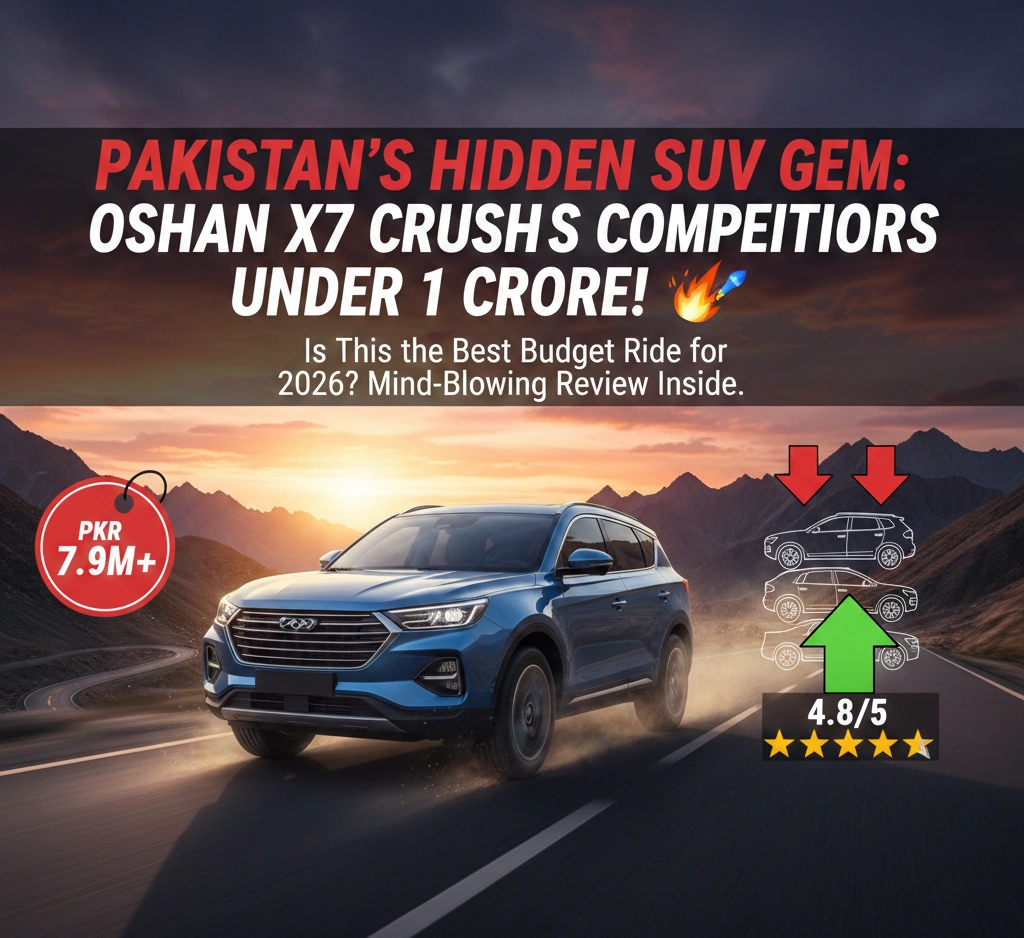

Imagine and Experience ! It’s a crisp January morning in Islamabad, and a family of six is loading up for a road trip to Hunza. Luggage piled high, kids arguing over window seats, and a father quietly confident that his new Changan Oshan X7 will eat up every kilometer between the capital and Karakoram without complaint. Three months earlier, he had test-driven the Toyota Fortuner, winced at the price tag, looked at the Haval H6, and eventually landed on something that surprised even him. “I didn’t expect a Chinese SUV to feel this premium,” he told me over the phone from somewhere near Besham. “But here we are.”
That story is no longer an outlier. In 2025, Pakistan’s budget crossover segment grew by 15 percent, fueled by relative fuel price stability and the early stages of an economic recovery that the IMF now projects will push GDP growth to 4–5 percent in 2026. Into that optimistic landscape, the Changan Oshan X7 has emerged as the country’s highest-selling 7-seater SUV—a remarkable achievement for a brand that many Pakistani buyers once regarded with polite skepticism.
So what is the Oshan X7, really? Is it the best budget SUV Pakistan can offer in 2026? Let’s go under the hood—and inside the cabin—to find out.
Design and Build Quality: Chinese Ambition, Global Execution
The Oshan X7 does not look like a budget compromise. Changan’s designers have given it a fastback-influenced roofline, LED daytime running lights that sweep upward like raised eyebrows, and a front grille wide enough to project authority without tipping into aggression. The body panels feel solid to the tap, the panel gaps are consistent, and the overall silhouette sits somewhere between a family hauler and a lifestyle statement.
At 4,750mm in length with a wheelbase of 2,810mm, it is a genuinely large vehicle—longer than the Haval H6 and competitive with vehicles costing significantly more. The 200mm of ground clearance is not an accident; it is a deliberate nod to Pakistan’s realities, where a potholed urban road and a partially washed-out mountain track can appear within the same hour.
Build quality, at least in early 2026 ownership reports, has held up well. One Lahore-based owner who had clocked 18,000 kilometers in eight months told PakWheels forum readers: “Not a single rattle, no paint issues, and the suspension still feels tight.” That is anecdotal, of course, but it echoes what quality-control data from Changan’s local assembly operations increasingly supports.

Performance and Handling: The 1.5 Turbo That Punches Well Above Its Weight
Under the hood sits a 1.5-liter turbocharged four-cylinder producing 185 horsepower and 300 Nm of torque. Paired with a 7-speed dual-clutch transmission (DCT), this powertrain has numbers that would have been firmly mid-range territory in Europe or the United States just a few years ago. In Pakistan’s budget segment, they are extraordinary.
Overtaking on the N-35 feels effortless. Urban merges into Karachi’s perpetual gridlock are handled with composure. The DCT shifts quickly at highway speeds and, once warmed up, behaves with minimal of the low-speed hesitation that plagued earlier Chinese DCT implementations. Steering is well-weighted—light enough for city maneuvering, firm enough to inspire confidence on a winding mountain road.
Ride quality is one of the Oshan X7’s genuine strengths. The suspension tuning appears calibrated specifically for broken surfaces. Large potholes are absorbed without drama. High-speed stability on the Motorway is commendable, with the car tracking straight and requiring minimal correction.
Does it handle like a performance SUV? No. Body roll in sharp corners is noticeable. But the target buyer is not looking for a canyon carver. They want a reliable, comfortable machine that can handle Lahore traffic on Monday and Kaghan Valley on Friday—and the Oshan X7 does precisely that.
Interior and Comfort: Where the Value Proposition Gets Real
Step inside the FutureSense variant and you will be greeted by a cabin that, by any honest measure, outpunches its price point. Genuine leather seating, a 12.3-inch touchscreen infotainment system, a digital instrument cluster, panoramic sunroof, and ambient lighting combine to create an environment that feels premium without feeling fraudulent.
The third-row seating—often an afterthought in 7-seaters at this price—is usable for adults on shorter journeys and genuinely comfortable for children. With all seats folded, the boot expands to a cavernous 1,407 liters, enough for serious luggage, camping gear, or, as one Peshawar buyer noted, “eight large suitcases when the relatives visit from abroad.”
Front passengers get the best of it: generous headroom, power-adjustable seats in higher trims, and a dual-zone climate system that actually works efficiently in Pakistan’s brutal summers. Rear passengers in the second row enjoy reclining seats and adequate legroom—rare at this price point.
Noise insulation is better than expected, though highway wind noise creeps in above 120 km/h. That is a minor criticism for a vehicle in this segment.
Safety Features: More Than the Minimum
Pakistan’s automotive safety standards have historically lagged behind regional peers, which makes the Oshan X7’s safety package genuinely noteworthy. Standard across the range: four airbags, ABS with EBD, electronic stability control, and hill-hold assist. Higher trims add a 360-degree camera system—invaluable for urban parking—and adaptive cruise control, a feature rarely seen at this price in any market.
The lane departure warning and blind-spot monitoring systems, offered on the FutureSense variant, add a layer of active safety increasingly demanded by younger Pakistani buyers who are more globally connected and safety-conscious than previous generations. According to Car and Driver’s global SUV safety benchmarks, adaptive safety suites in the USD 25,000–30,000 equivalent segment are now table stakes internationally; the Oshan X7 meets that standard locally at roughly half the dollar cost.
Fuel Efficiency and Running Costs: The Number Every Pakistani Buyer Actually Cares About
At current PKR fuel prices, running costs are the deciding factor for the majority of buyers in this segment. The Oshan X7’s official fuel efficiency range is 10–14 km/L, and real-world owner data largely validates that spread. Urban driving in stop-and-go traffic yields 10–11 km/L. Consistent highway cruising, particularly on the Motorway between Lahore and Islamabad, produces 13–14 km/L—a figure one owner called “genuinely surprising for a 185-horsepower SUV carrying five people and their luggage.”
At 14 km/L on a highway journey from Rawalpindi to Gilgit, fuel costs remain manageable even as petrol prices fluctuate. Compared to the Toyota Fortuner’s V6 engine averaging 8–9 km/L, or even the diesel variants of competitors that require more expensive servicing, the Oshan X7’s economics are compelling. Maintenance costs, supported by Changan’s growing dealer network across Pakistan, are also significantly lower than Japanese rivals at equivalent mileage intervals.
Oshan X7 vs. Competitors: How Does It Stack Up?
| Feature | Oshan X7 FutureSense | Haval H6 HEV | Toyota Fortuner |
|---|---|---|---|
| Price (PKR) | ~9,299,000 | ~10,500,000+ | ~14,000,000+ |
| Engine | 1.5T (185 HP) | 1.5T Hybrid | 2.7L / 2.8L Diesel |
| Seating | 7 | 5 | 7 |
| Boot Space | 1,407L | 723L | 820L |
| Fuel Average | 10–14 km/L | 16–18 km/L | 8–10 km/L |
| 360° Camera | Yes | Yes | No (base) |
| Panoramic Roof | Yes | Yes | No |
The Haval H6 HEV offers superior fuel efficiency but loses on seating capacity, boot space, and price. The Toyota Fortuner carries the weight of reputation and residual value—but at a premium that puts it out of reach for the majority of Pakistani middle-class buyers in 2026. The Oshan X7 occupies a sweet spot that neither competitor fully claims: seven seats, a large boot, genuine premium features, and a price that begins at PKR 7,949,000 for the Comfort variant.
According to UrduPoint’s latest SUV market data, the Oshan X7 has consistently ranked as the segment leader in 7-seater sales since mid-2025, a position driven by exactly this value calculus.
The Bigger Picture: China’s Auto Disruption and Pakistan’s Economic Moment
There is a macro story here that goes beyond a single SUV review. Chinese automotive brands—Changan, Haval, MG, BYD—are systematically dismantling the price premiums that Japanese and Korean automakers once commanded in developing markets. Pakistan, grappling with inflation and a weakened rupee, has proven particularly receptive. Where a Toyota or Honda once represented the only “safe” choice for a middle-class buyer, brands like Changan have introduced competitive quality at prices that make the calculation genuinely difficult.
The Oshan X7’s pricing strategy is partly a function of local assembly under Pakistan’s Greenfield investment policy, which reduces import duties and allows Changan to offer a globally competitive product at a locally accessible price. As Pakistan’s economic trajectory improves—with GDP growth projected at 4–5 percent in 2026 and inflation slowly moderating—consumer confidence in larger-ticket purchases like SUVs is rising. Changan is positioned to capture that rising tide.
For buyers wary of residual value—a legitimate concern with newer Chinese brands—the picture is improving. Changan’s after-sales network has expanded to over 50 cities, parts availability has improved substantially since 2023, and used-market prices for the Oshan X7 have held steadier than many early skeptics predicted.
Adventure Ready: From Urban Commutes to the Karakoram
For Expedia-reading travel enthusiasts planning Pakistan’s extraordinary northern routes, the Oshan X7 deserves specific mention. The 200mm ground clearance handles the rough approach roads to Fairy Meadows or the rocky patches near Skardu with composure. The spacious third row means the whole family can make the Hunza Valley run without anyone being left behind or cramped into a second vehicle. The large panoramic sunroof transforms mountain driving into something genuinely cinematic.
The 360-degree camera system, meanwhile, proves its worth not just in parking lots but on narrow mountain roads where one mirror isn’t enough. One Rawalpindi-based travel blogger who drove the route to Naran twice in the Oshan X7 described it as “the first time I’ve done this drive without feeling like the car was working too hard.”
Pros, Cons, and Buying Advice
What works:
- Exceptional value at PKR 7,949,000–9,299,000 for a fully-featured 7-seater
- 185 HP turbocharged engine delivers confidence across terrain types
- Premium cabin quality that genuinely rivals vehicles costing significantly more
- Strong fuel efficiency for the segment (10–14 km/L real-world)
- 360-degree camera, adaptive cruise, and panoramic sunroof at this price are remarkable
- 1,407L boot capacity is class-leading
What to consider:
- Third-row comfort is adequate rather than generous for adults on long drives
- Resale value, while improving, still trails Japanese competitors
- DCT can feel hesitant in heavy low-speed traffic
- Wind noise above 120 km/h is present, if not dramatic
Who should buy it: The Oshan X7 is the right choice for families who need seven seats, value genuine premium features, drive a mix of urban and highway routes, and want the best possible specification at under PKR 10 million. If Toyota Fortuner residuals are your primary concern and budget is secondary, look elsewhere. But if you want the most car for your money in Pakistan in 2026—and you want it to be genuinely good—the Oshan X7 makes a compelling case that is increasingly hard to argue against.
Ready to experience Pakistan’s best-value 7-seater SUV for yourself? Visit your nearest Changan Pakistan showroom to book a test drive, or browse detailed ownership reviews at PakWheels before you decide. The roads to Hunza aren’t getting any shorter—but the right vehicle makes the journey considerably better.




Leave a comment